WooCommerce Product Reviews: What Your Store Needs to Turn Browsers Into Buyers

Table of Contents
- Products with reviews sell better than products without reviews
- Why product reviews drive sales
- Where identity signaling really moves the needle
- How to get more product reviews for your WooCommerce store
- You have to ask for product reviews
- Make it easy: Get the customer right to the review form
- What Do Your WooCommerce Product Reviews Need To Be Great?
- Reviews Should Be Searchable
- Reviews Should Be Filterable and Sortable
- Reviews Should Be Editable
- Reviews Should Allow Feedback From Other Shoppers
- Reviews Should Be Media-Rich
- Reviews Should Be Translated for Multilingual Stores
- Reviews Should Include Those Crazy One-Star Reviews
- Reviews Need SEO Rich Snippets
- The Best Plugins and Services for Great WooCommerce Product Reviews
- Self-Hosted WordPress Plugins: Budget-Friendly Choices
- SaaS / Hosted Services: More Advanced Features and Hands-Off Management
- Why we recommend reviewbird
- Implementing Your Product Review Strategy
- It's time to take your Woo product reviews to the next level
It’s 2026 and having a great looking website, with good UX and design is easier than ever. Millions of stores are competing for customer’s attention. How do they choose between your offering and the zillions of other offers?
Think about your last trip to Amazon. If you’re like me, you probably mostly skipped the listing description (at best a brochure with some product specifications), ignored the ads, and zeroed in on a product with lots of verified reviews. You clicked on the pictures to see what it really looks like. If you’re especially nerdy about it, you looked at the most recent reviews, looked at the negative reviews, and then maybe even searched the reviews for something specific. And taking it all into account, you made a purchase.
That’s because reviews drive sales. Real reviews. Reviews with typos. Reviews with blurry photos.
Reviews are social proof that what a seller claims about their product is actually true.
If you haven’t spent time optimizing your WooCommerce product reviews, this guide is your roadmap. I’ll break down why reviews dominate customer decisions, common pitfalls many merchants miss, important features that make a real difference, and the best tools to turn your WooCommerce product reviews into a sales engine.
Products with reviews sell better than products without reviews
And not just a little better, a lot better. Spiegel Research Center found that products with just five reviews are 270% more likely to be purchased than products with zero. For expensive items, that number jumps to 380%. Reviews aren’t a nice-to-have, they are the foundation of trust in purchasing decisions for most shoppers.
Products with just five reviews are 270% more likely to be purchased than products with zero reviews.
If you’re running a WooCommerce store and haven’t invested serious thought into how you collect, display, and manage your WooCommerce product reviews, you’re leaving money on the table. And maybe a lot of money.
Why product reviews drive sales
Product reviews do at least four things simultaneously:
Social proof: Humans are social to their core. We intuitively and instinctually take our cues from others. In fact, we hardly do anything without considering social impact. When we see that 847 people bought this camping hammock and give it high marks, we immediately feel safe.
Fear reduction: A customer looking at your $200 kitchen knife set isn’t just asking “Is this good?” They’re asking “What could go wrong?” Reviews answer that question before they have to ask it. And here’s the interesting part: if a customer reads a complaint in the reviews and decides to buy anyway, they’ve already processed that risk. If that particular issue impacts them, they’re not angry. They made an informed decision.
Solution validation: Customers aren’t just browsing. Many of them have a specific problem and they want to know if your product solves it. A USB-C hub with reviews mentioning “works perfectly with my MacBook Pro M3” is worth more to a MacBook owner than any spec sheet you could write.
Identity signaling: When people are making buying decisions, they are fundamentally asking an identity question: Do people like me buy things like this?
Prospective buyers are fundamentally asking “Do people like me buy things like this?”
Seth Godin argues that purchasing decisions are fundamentally identity decisions. We’re not just asking “Is this product good?” We’re asking “Do people like me buy things like this?”
Where identity signaling really moves the needle
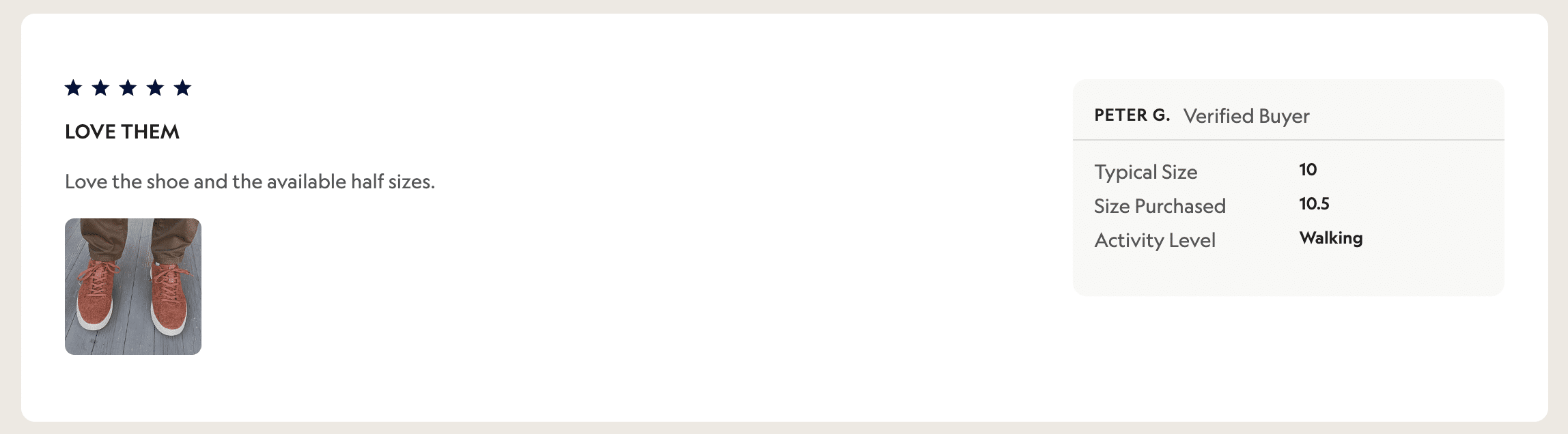
This plays out most visibly in fashion and lifestyle products. When a woman sees another woman wearing that dress in a candid photo review, she’s not evaluating thread count. She’s thinking “She looks like me, and she looks great.” That’s an identity confirmation.
But identity signaling isn’t limited to fashion. The type of person who runs Linux is making an identity statement. So is the person who buys a cast iron skillet instead of a non-stick pan, or the business owner who chooses self-hosted WooCommerce over a managed Shopify plan. Product reviews give potential buyers the chance to see themselves reflected in your customer base.
How to get more product reviews for your WooCommerce store
The mistake most merchants make is expecting customers to leave product reviews out of their own good will. Statistically, this doesn’t happen very often. 70% of online reviews come from businesses explicitly requesting feedback from customers.
If you leave it to chance, you’re not going to get many reviews. And worse, the reviews you do get may skew negative in a way that misrepresents how customers actually feel about your product.
You have to ask for product reviews
Review requests via email or SMS are the best way to increase your review count. These requests should come after the customer has received their product and gotten a chance to use it. The experience should be fresh.
14 days is a good bench mark to shoot for. If you wait too long, their memory of their experience will fade and their motivation to participate will go down.
You have to ask: Review request emails are responsible for 70% of reviews
Make it easy: Get the customer right to the review form
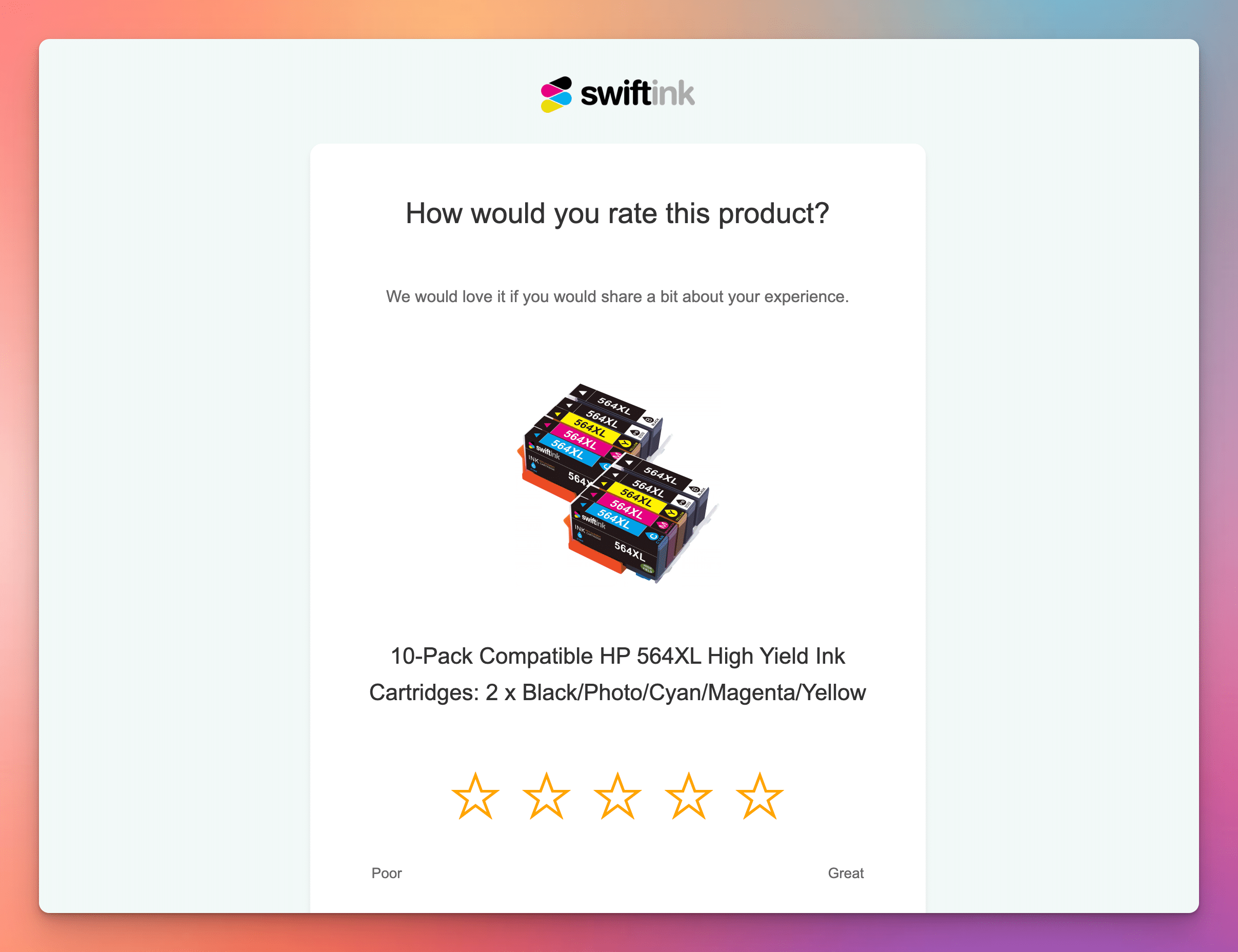
Sending an email or a text message is great, but if you drop them off on the product page and make them search for the leave a review button people are going to lose interest.
Instead, get them right to the review form and let them select their rating directly in the email:
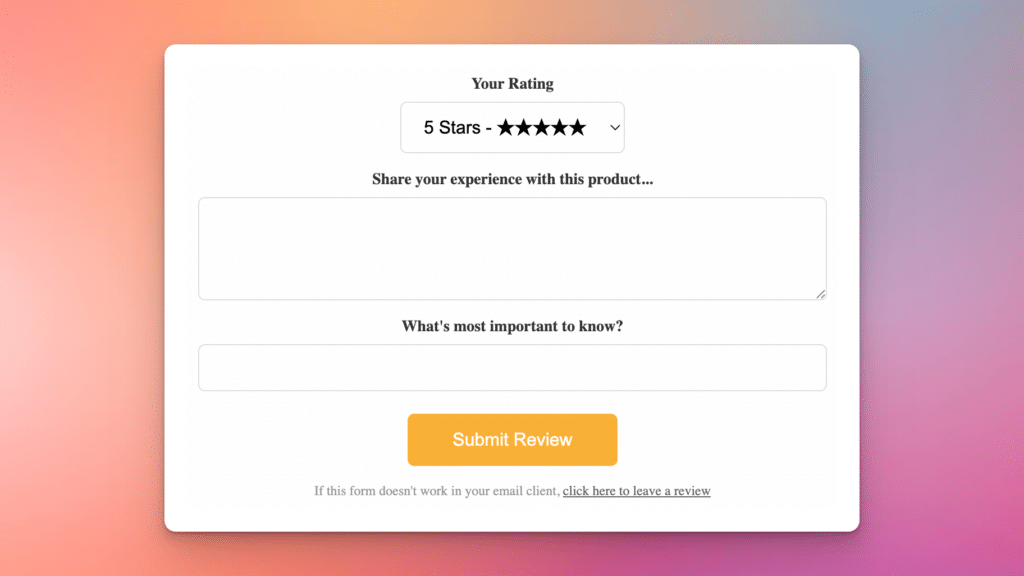
Another alternative is embedding the review form right in the email. This doesn’t work with every email client, but it can increase your success rate for those customers who do have a supported email client.
What Do Your WooCommerce Product Reviews Need To Be Great?
WooCommerce ships with a built-in product reviews feature, but it’s very bare-bones and not enough for most merchants.
Before we get into solutions, let’s talk about the types of features your store needs to leverage the power of product reviews.
Reviews Should Be Searchable
This is the one feature that separates a review section from a real research tool.
Imagine you sell a universal phone mount for cars. A customer with a Pixel 9 wants to know if it fits their phone. They don’t want to read 200 reviews. They want to type “Pixel” and see if anyone mentions it.
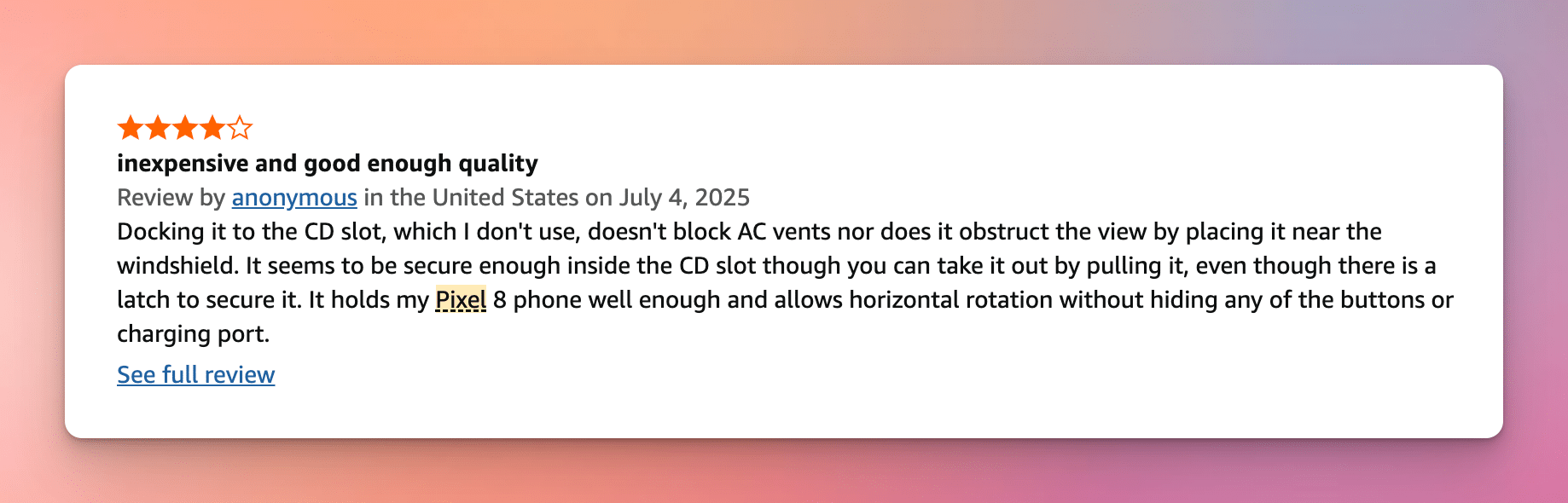
Searchable reviews cater to the power user who already knows what they want to know. They just need confirmation. That confirmation is often the last thing standing between a browser and a purchaser.
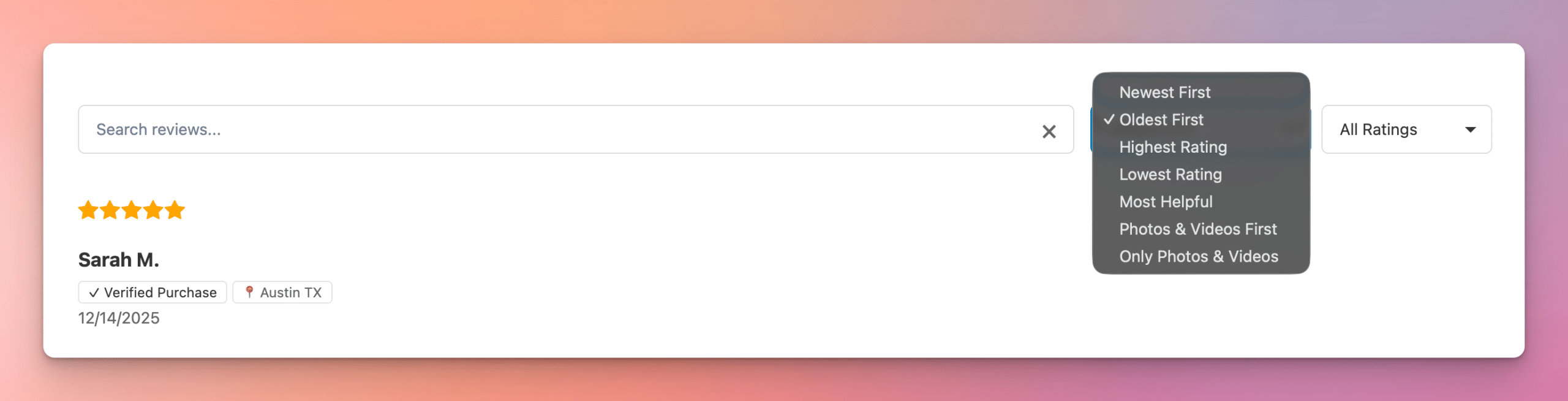
Reviews Should Be Filterable and Sortable
Filtering by star rating is the most underappreciated conversion tool on a product page.
Why would anyone deliberately filter to one-star reviews? Because they’re trying to answer the question: “What’s the worst thing that could happen?” And if the worst thing that could happen is something they don’t care about (the color was slightly different than the photo, the packaging was dented), they can buy with confidence. Filtering to three-star reviews answers a different question: “What’s the medium experience?” Some customers want to know what “just okay” looks like.
Sorting is equally important. By making your reviews sortable, you help customers find the reviews they actually care about.
Reviews Should Be Editable
Your customers’ experience with a product changes over time. An initially rocky experience (confusing setup, missing instructions) might lead to a great outcome after they have more experience using your product. A review written on day one might look very different from one written on day thirty.
A proper review system lets customers go back and update their reviews. This is good for everyone: the customer feels heard, the store gets a more accurate representation of the experience, and future buyers get a more complete picture.
Reviews Should Allow Feedback From Other Shoppers
“Helpful” buttons on reviews add another layer of social proof.
When a shopper reads a detailed, thoughtful review and sees that 47 other people found it helpful, two things happen. First, they trust that review more. Second, they feel validated in their own assessment of it. “I found this review helpful, and so do 47 other people.” It’s the reviews reviewing themselves.
This feature also surfaces the best reviews to the top over time, which means your review section gets better without you doing anything. Win win!
Reviews Should Be Media-Rich
Text reviews are valuable. Photo and video reviews can be even more valuable.
Shoppers want to see what your product looks like in the real world, not in your studio with perfect lighting and a professional model. How does that dress look on someone who isn’t 5’10” and a size 2? What does the desk look like in an actual apartment instead of a minimalist showroom set?
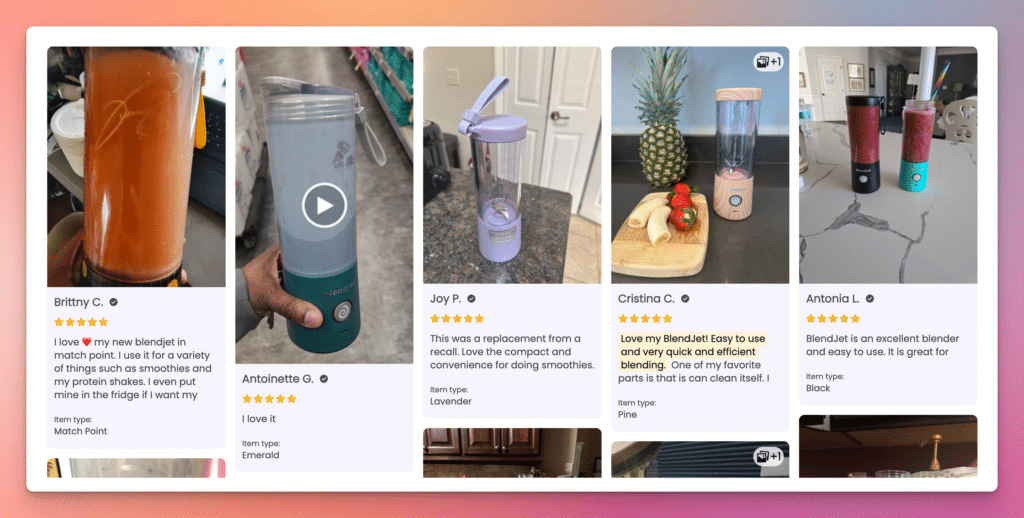
For lifestyle and fashion products, customer photos close the loop on the Seth Godin identity question. When a potential buyer scrolls through review photos and sees someone who looks like them, living a life like theirs, wearing or using the product: that’s the most powerful sales tool you have. PowerReviews found that interactions with image galleries on product pages increase conversions by 110.7%.
Reviews Should Be Translated for Multilingual Stores
If you sell internationally, you risk siloing your best validation into language buckets. A French customer can’t benefit from 500 English-language reviews, and vice versa. That’s a big waste of valuable content!
Automatic translation isn’t perfect, but the advent of AI tools for translation makes it more than good enough! Translated reviews open up all of your reviews to all of your customers. And that’s a pretty powerful reason to include it.
Reviews Should Include Those Crazy One-Star Reviews
As merchants it goes against our intuition, but the data shows that 95% of consumers suspect censored or fake reviews if there aren’t any negative ones.
A product page with nothing but five-star reviews doesn’t look trustworthy. It looks curated. Customers know that no product is perfect for everyone, and when every single review is glowing, their internal alarm bells go off.
One-star reviews actually help you in two ways. First, the people who leave one-star reviews are often… let’s say, operating with a lot of emotion. When a potential buyer reads a one-star review that says “I HATE THIS PRODUCT. IT ARRIVED ON WEDNESDAY INSTEAD OF TUESDAY AND THE BOX WAS SLIGHTLY DENTED,” they think: “Okay, that person has a different threshold than I do.” The review actually reassures them.
Second, when the one-star review is legitimate and describes a real problem, it answers the “worst case scenario” question. If the worst thing about your camping hammock is that it’s too short for people over 6’2″, and the buyer is 5’8″, they just got confirmation that none of the complaints apply to them. That’s a green light to purchase!
Reviews Need SEO Rich Snippets
Review schema markup determines whether your star ratings actually show up in Google search results and those rich snippets can boost click-through rates by 30% or more.
WooCommerce includes basic product schema out of the box, but it doesn’t generate the detailed review structured data needed to trigger those star ratings in search results. And when shoppers compare two similar product search results – one displaying a 4.5-star rating with review counts, the other just plain text – they click the one with visible social proof every time.
Proper review schema tells Google exactly what your customers think about your products. It transforms your search listings from generic blue links into trust-building snippets that immediately stand out from competitors who haven’t done the work.
The Best Plugins and Services for Great WooCommerce Product Reviews
So how can we fix our WooCommerce product reviews and take them from mediocre to awesome? Let’s go through the options.
(Don’t want to read through the options? Here’s a spoiler alert: we recommend Reviewbird for WooCommerce product reviews.)
Self-Hosted WordPress Plugins: Budget-Friendly Choices
There are a few WooCommerce plugins that extend the review functionality of WooCommerce:
These plugins check a lot of the boxes above. They allow searching and sorting, and photos (sometimes videos) and various display options. The include schema information for rich snippets and email reminders to leave reviews.
One area that these plugins struggle in is design:
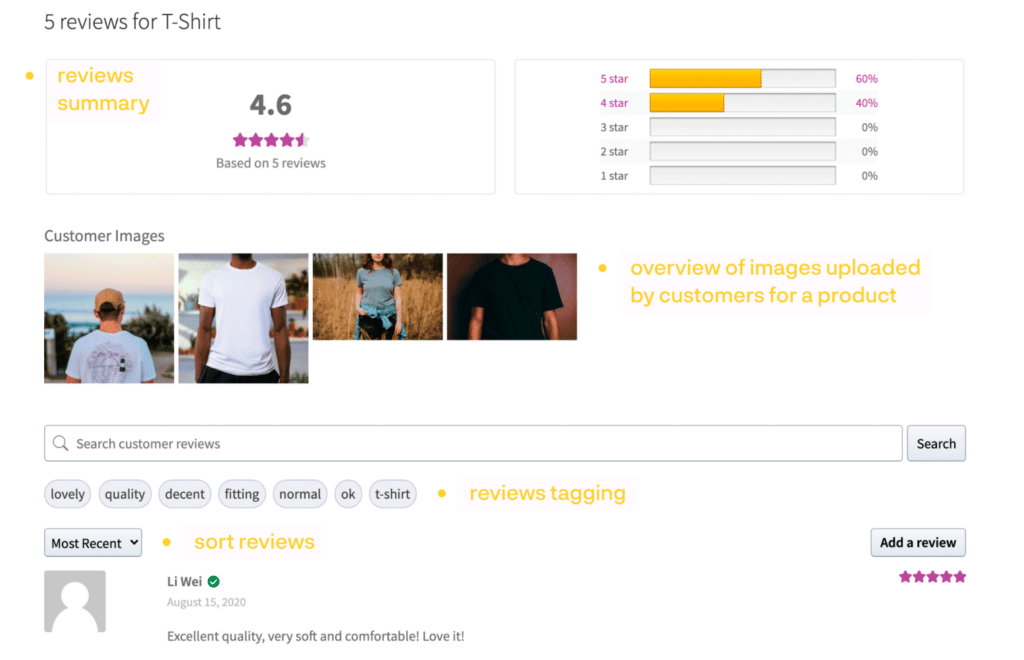
Taste is subjective, but in 2026 customers have high expectations and a clunky Web 2.0 era design isn’t going to cut it.
Another potential downside is performance: if you’re Woo site isn’t on fast hosting (it should be!) you may face bottlenecks with DB performance and storage. Even premium managed hosts are pretty stingy with storage space these days, and including photo and video uploads can compound that problem.
You can manage storage problems with Amazon S3 and similar offerings, but that adds to the complexity.
AI features are also hard to provide with a plugin. Automated features like moderation (especially moderation of images and videos), translation, and summarization are a great way to leverage the power of AI, but the limitations of hosting and API keys make it difficult.
Personally Identifiable Information (PII) detection is another overlooked feature that plugins generally leave out. PII detection avoid accidental data leaks from customers mistakenly using your review form like a support form and sending sensitive information like addresses, or worse credit card numbers. (It happens more than you would think!)
Overall, these plugins work well for stores that need the basics and prefer self-hosted solutions: review requests, photos, videos all greatly enhance the basic review functionality of WooCommerce.
And if store isn’t making a lot of sales, it may be wise to stick with a self-hosted solution until you outgrow it.
SaaS / Hosted Services: More Advanced Features and Hands-Off Management
There are quite a few hosted review services that integrate with WooCommerce. Here are a few SaaS products that check the boxes:
- Reviewbird (our favorite)
- stamped.io
- reviews.io
- WiserReview
These review solutions tend to be multi-platform and the price ranges from $10/mo to hundreds of dollars per month.
When you choose a hosted solution, you’re offloading the hosting, performance, storage costs, email deliverability, etc to that service. For many merchants this makes a lot of sense. Running a self-hosted ecommerce site is already a lot of work and the ability to offload the responsibility means one less thing to worry about.
You don’t need to worry about SMTP configurations, API keys, file storage, etc. These solutions handle everything for you and consequently are able to offer more features than a self-hosted plugin solution.
Why we recommend reviewbird
For WooCommerce stores, we recommend Reviewbird. It’s built by seasoned WooCommerce developers for WooCommerce stores.
Reviewbird handles review request emails, discount incentives, moderation, translation, AI summaries, photos, videos, etc and it’s one of the least expensive options.
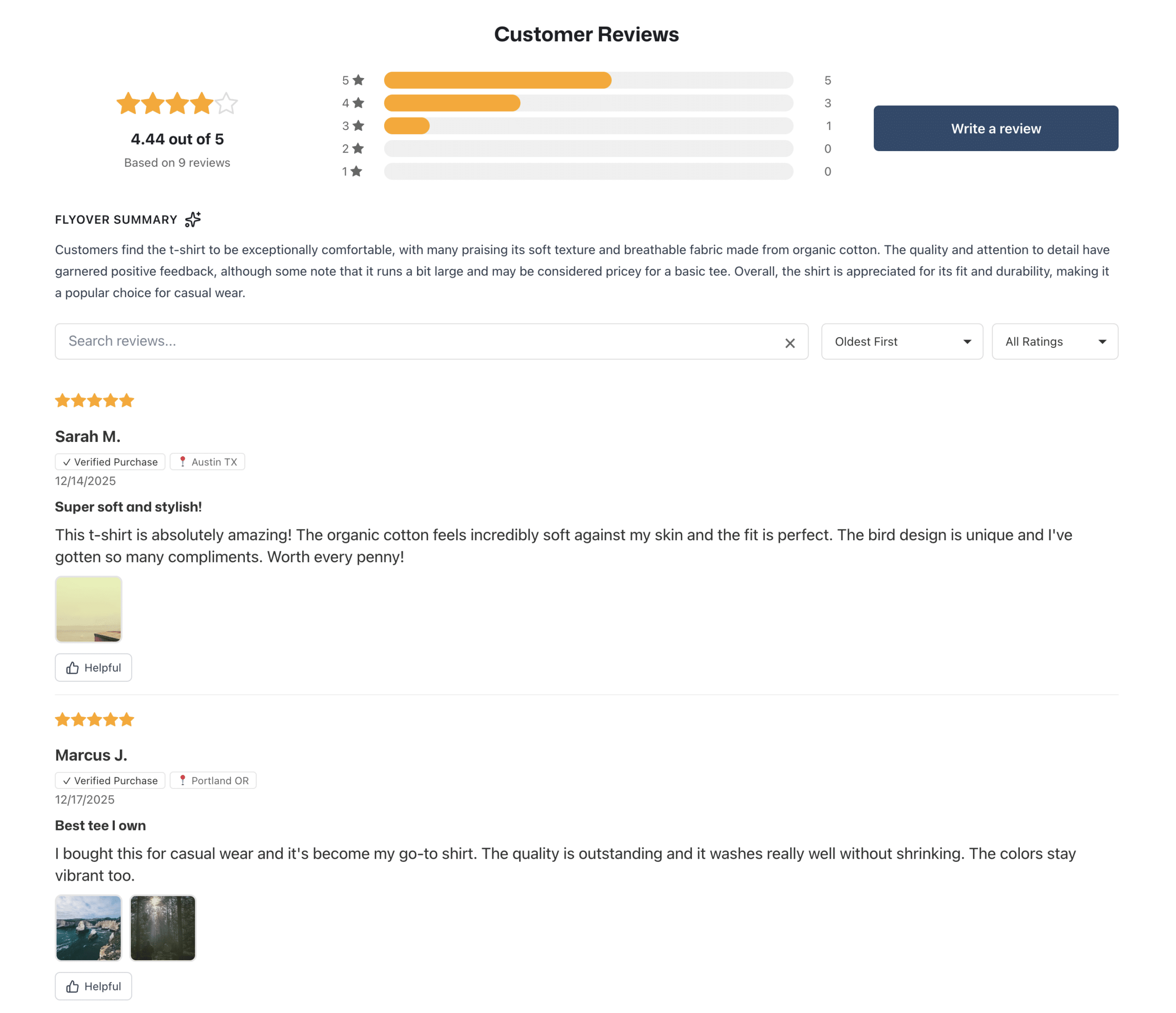
Reviewbird also has those advanced AI-powered features that plugins generally lack: moderation that categorizes incoming reviews as spam, off-topic, or offensive, summarization of customer reviews, etc.
It integrates with Google’s review programs. And because it’s a SaaS platform, the review rendering is handled externally, so your WordPress site’s performance isn’t dragged down by a constantly growing database.
It’s not the cheapest option (it’s a paid SaaS, not a free plugin). And if you only need basic star ratings with no photos, no search, and no automation, a free plugin like CusRev may be a better place to start.
But if you’re serious about reviews and you want a solution that just works, Reviewbird is a great option.
Implementing Your Product Review Strategy
Product reviews are one of those areas in ecommerce where the investment pays for itself almost immediately. One review can improve your conversion rate by 10%. Five reviews can change it by 270%.
But the investment isn’t just in picking a tool. It’s in building the system around it. That means:
Timing your review requests intentionally. Not too early, not too late. After delivery, while the experience is fresh.
Making it easy to leave a review. One-click star ratings from the email. Photo upload that works on mobile. A form that doesn’t ask for more information than necessary.
Leave the bad reviews up unless you have a good reason. Resist the urge to hide them. They make the good reviews more believable, and they give uncertain buyers the permission to purchase despite imperfections.
Encouraging media-rich reviews. Consider offering a small incentive (like a coupon code) for reviews that include photos or video. Those reviews are disproportionately valuable.
Choosing a tool that matches your ambitions. If you’re doing $500/month or less and just need basic reviews, a free plugin is the way to go. If you’re doing $5,000/month and trying to optimize conversion, you need searchable, filterable, media-rich, multilingual reviews with automated collection.
It’s time to take your Woo product reviews to the next level
The best time to build up your review game was probably six months ago. But the second best time is right now, while you still have time to collect reviews before the next big sales season. Start by picking one thing from this guide that your current setup doesn’t do, and fix it. Then do the next one. The compound effect of a well-executed review strategy is one of the most reliable growth levers in e-commerce. Or pick a solution that handles them all.
Your customers are already deciding whether to trust you based on what other customers say. The only question is whether you’re giving your customers the tools to say it well.